


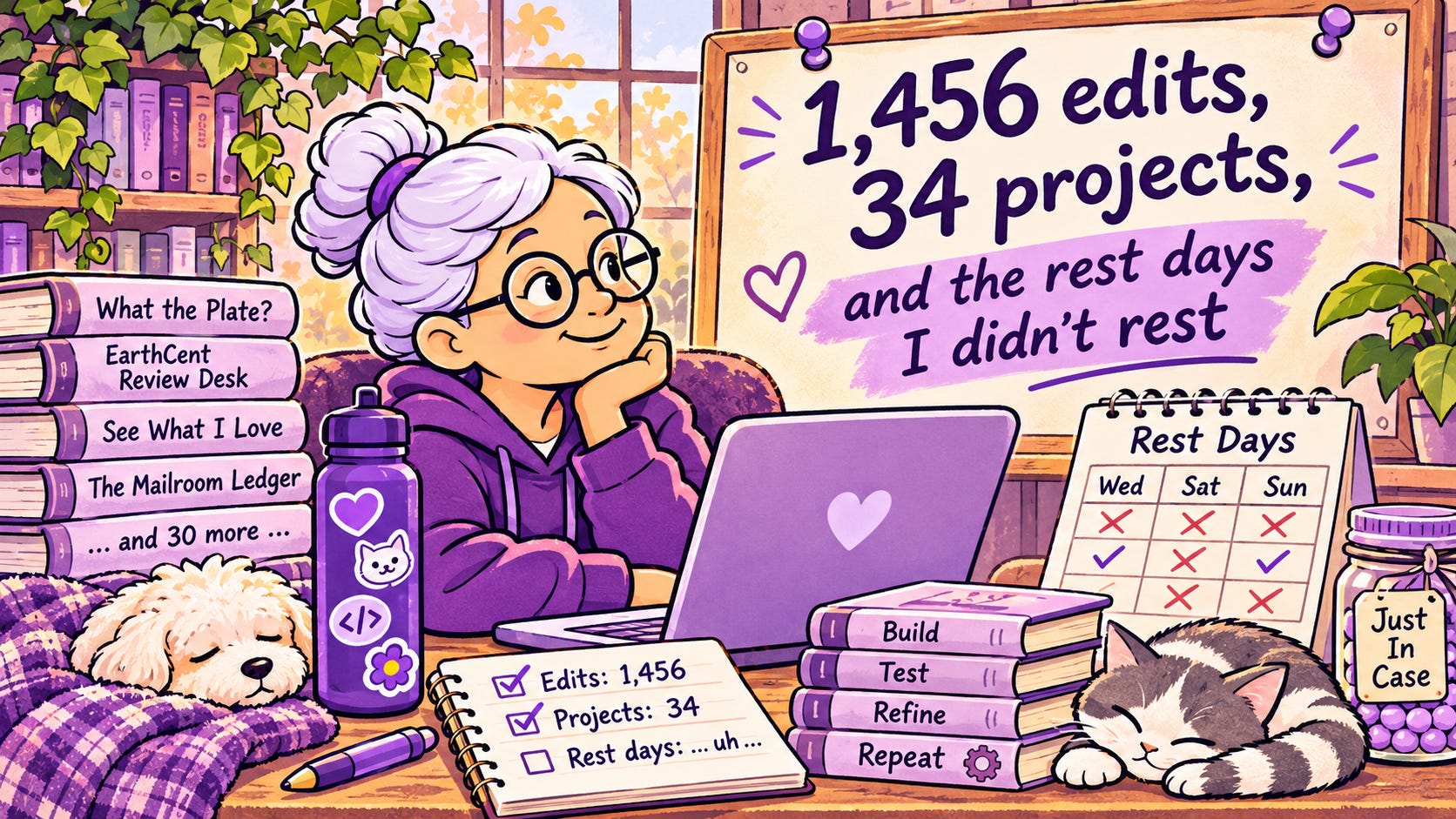
I signed up for Lovable on July 1. I didn’t want to start touching any code until I was well and truly retired. I had a ton of ideas and had a GitHub board tracking them, but no real code. Since then I’ve used Lovable 64 days of 138 calendar days. Hum. So it was time to dig in to what I’ve been doing.
Yesterday when I pulled my Lovable data I found 1,456 edits across 34 projects. Some of those projects are tools I use every week. Some lasted one evening. One of them, a t-shirt giveaway for Code Like A Little Old Lady, was the very first thing I built, on day one.
Those are only the projects I kept. I deleted about a dozen quick throwaways along the way, and their edits aren't counted here. The real totals are a little higher.
All the projects allowed me to try something different that I had not done before. It also helped me define my process. And of course, I’ve created a few GitHub libraries that facilitate my dev cycle.
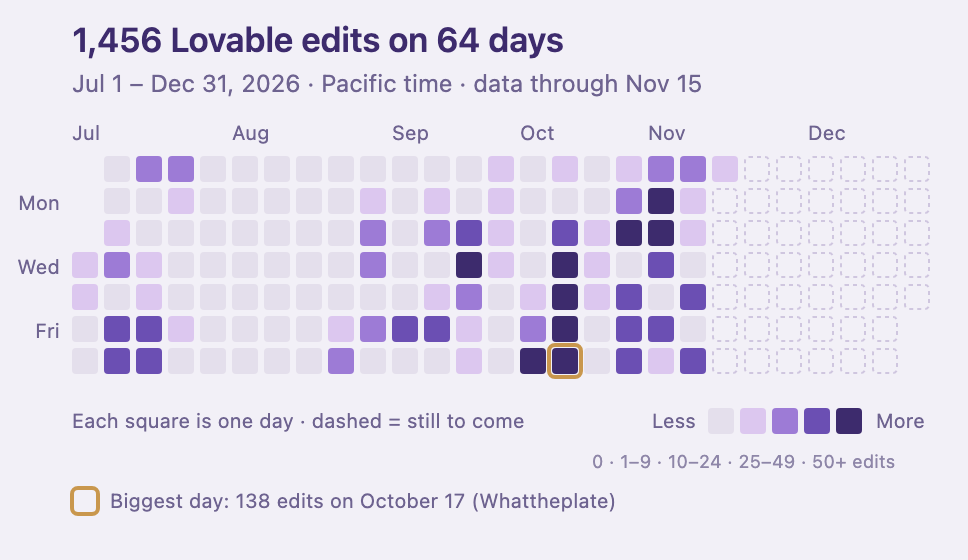
I wanted to know what those 64 days actually looked like. So I exported every edit, matched each project to its GitHub repository, converted every timestamp to Pacific time, and made myself a heatmap like the one GitHub draws for contributions. Here’s what I found.
A strong start, a long pause, and a comeback
July was a sprint. I built the giveaway page on July 1, then spent most of the month on See What I Love, a wishlist app I wrote about as The Lovable Diaries. By July 24 I had made 222 edits.
Then I stopped. For 34 days, from July 25 to August 27, I didn’t touch Lovable at all. This is when retirement hit me full in the face.
When I came back on August 28, it was to build something I needed: The Mailroom Ledger, a tool that turns Substack’s notification emails into a queue I can actually work through. From there, every month was bigger than the last.
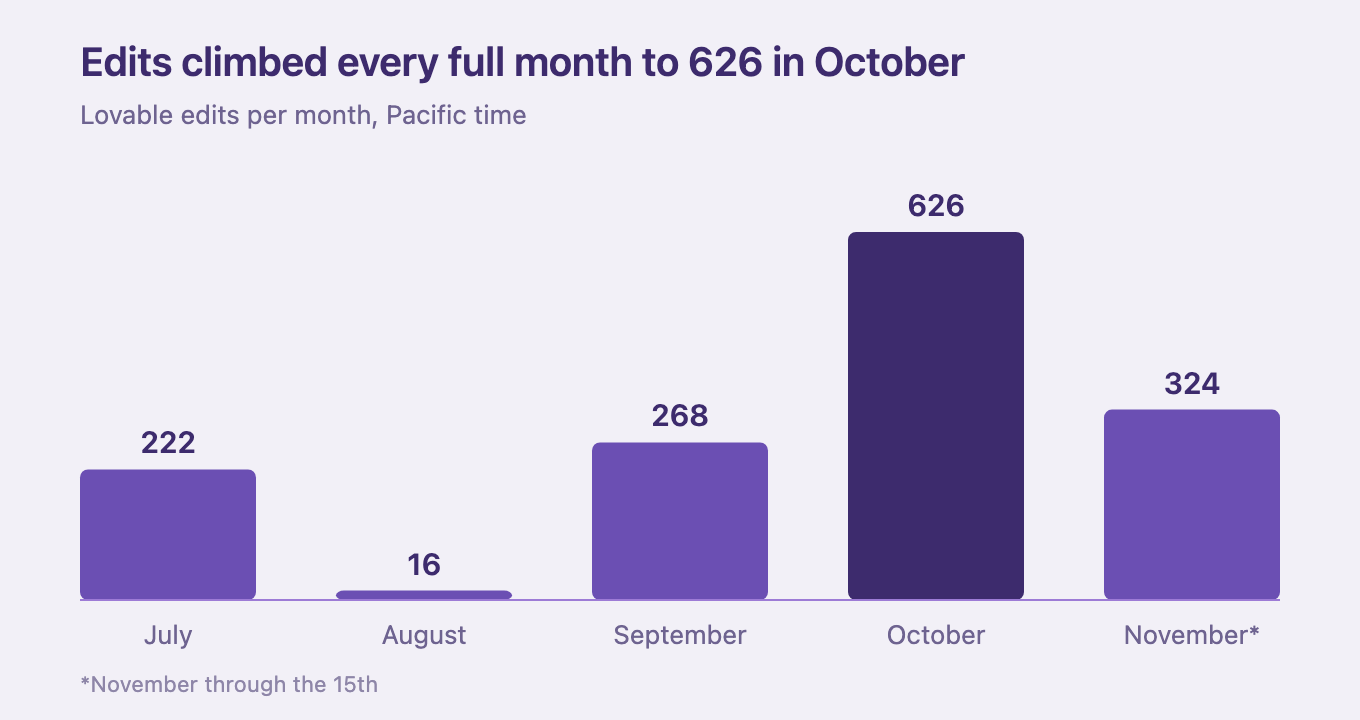
Halfway through November, I’m already more than halfway to October’s total.
What I actually build
Four projects account for 70% of my edits. The other 30 share what’s left.
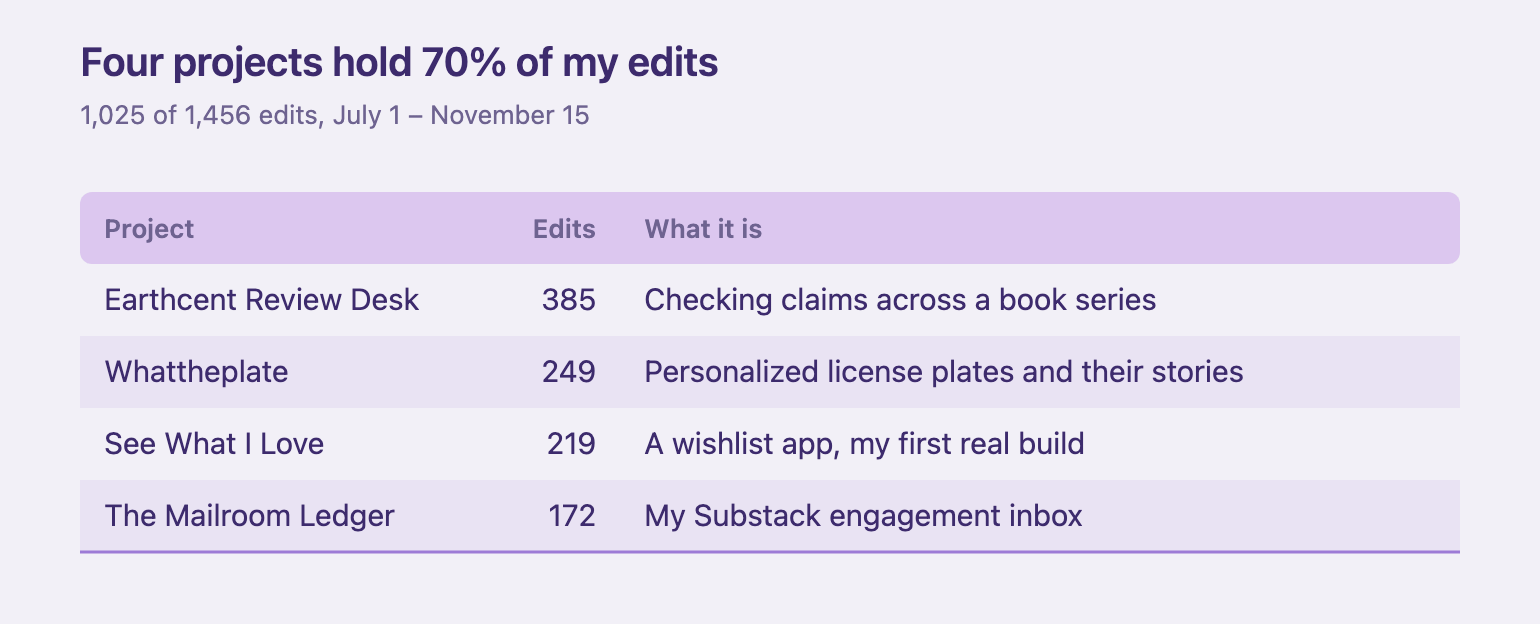
The long tail tells its own story. There are starter kits I built so the next project starts faster. There are tools for running Substack collaborations. There are my résumé pages, project portfolios, and tools to manage all my craft inventory. And there are plenty of one-evening experiments that never got a second visit.
Two-thirds of the edits are Lovable’s AI making changes I asked for (948). Most of the other third (499) are commits I pushed from GitHub, often written with Claude Code. That includes 141 merged pull requests. My edit titles also name my reviewers: Rowan and Lovelace, the AI agents who look over plans and code before they ship.
Deep days and juggling days
My biggest day was Saturday, October 17: 138 edits, all on Whattheplate. I worked through a numbered plan step by step, merging one pull request after another, from Step 43 to Step 51. This was SheBuilds. It was exhilarating. And the week or so before it prepping even more so.
Most days look like that one, just smaller. On 45 of my 64 days, I worked on a single project. My heaviest days are almost always focused ones.
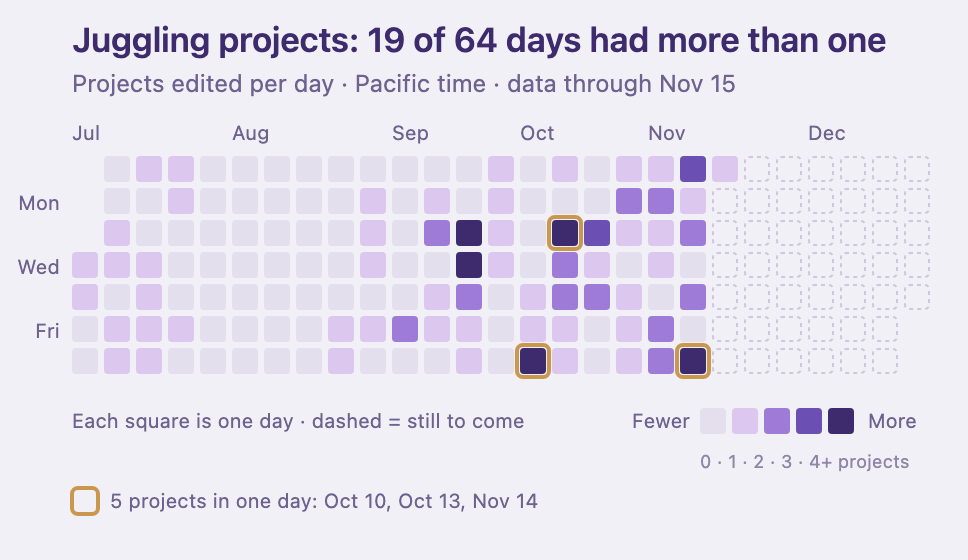
But on 19 days I juggled two or more, and on three days I touched five:
October 10: All Wrapped Up, PawPrint, CLALOL Workshop, the Collaboration Calendar and Cozy Landing.
October 13: infrastructure day. Two Supabase starter kits, Shelf Notes Home, Cozy Landing and the Calendar.
November 14: résumé and CLALOL pages, plus Schema Sandbox.
Every one of those juggling days falls on or after September 11. In July I worked on one thing at a time. Now I keep several going at once.
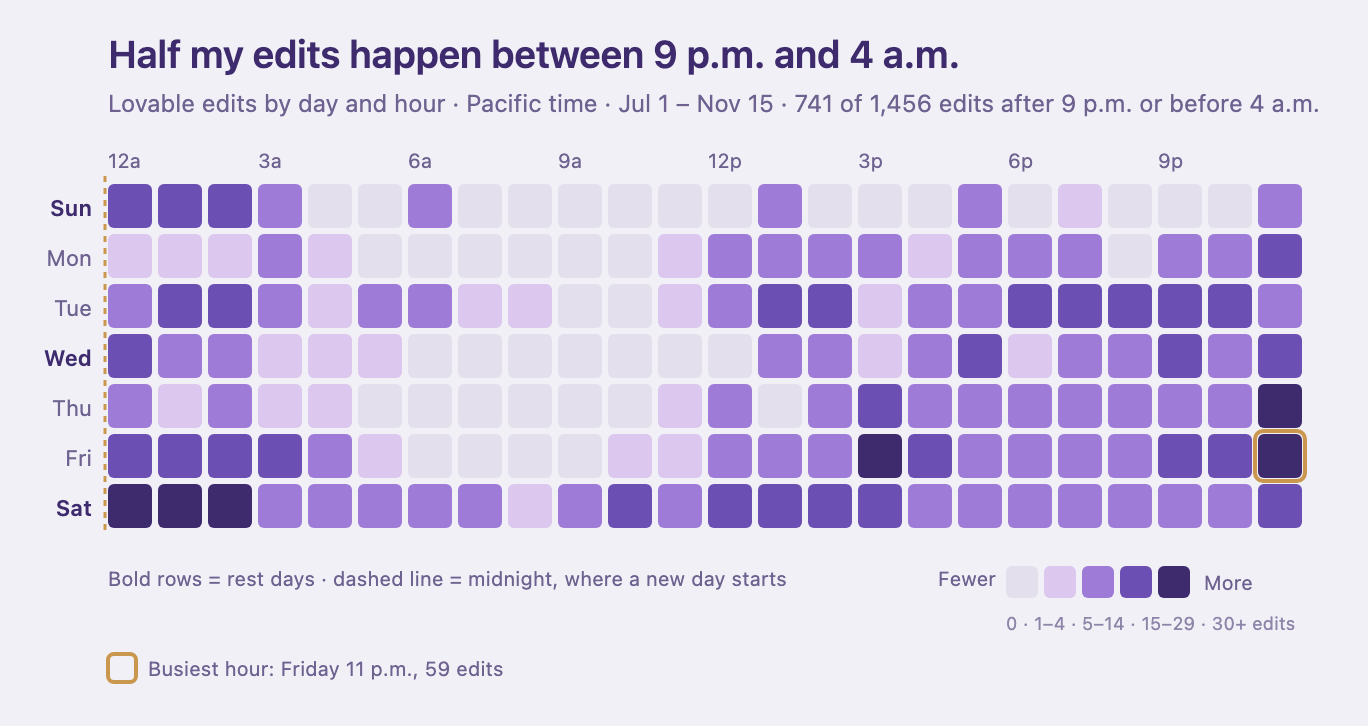
I also work late. Half of my edits happen between 9 p.m. and 4 a.m. More than a quarter of my edits come after midnight. My single busiest hour is Friday at 11 p.m., with 59 edits, and it runs straight into Saturday: the hours from midnight to 3 a.m. on Saturday are among my busiest of the week.
The boundary I keep crossing
I promised my family, no coding on Wednesdays, Saturdays or Sundays. Those are my rest days. Since July 1 there have been 60 of them, and I coded on 26.
That’s 43% of my rest days. For comparison, I coded on 49% of my allowed days (38 of 78). I keep my rest days only a little more often than I use my coding days.
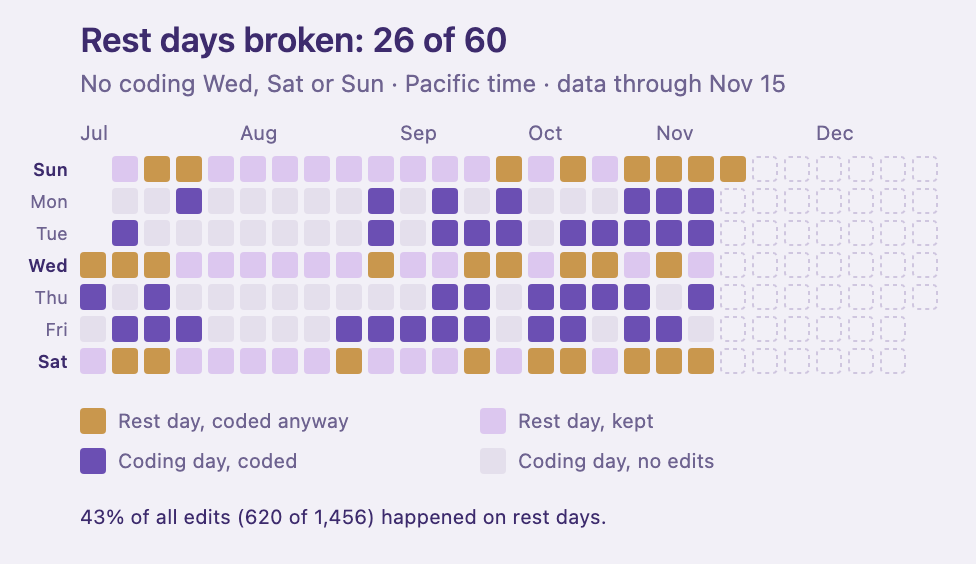
Saturday is where the rule breaks hardest. I coded on 9 of 20 Saturdays, and they hold 354 edits, more than any other day of the week.
Wednesday is close behind, 9 of 20.
Sunday holds up best. I coded on 8 of 20, but lightly: Sunday is my quietest day, with 92 edits in all.
All together, 620 of my 1,456 edits (43%) happened on days I’d promised not to code. My biggest day ever, that 138-edit Whattheplate Saturday, was a rest day. I kept both days of the weekend only 10 times out of 20, and half of those were during my summer break.
November has been the worst so far: I’ve coded on 6 of its 7 rest days.
One honest footnote: a day starts at midnight here. Since more than a quarter of my edits happen after midnight, some of my “Wednesday” edits are really Tuesday night that ran long.
Where the code lives
If you had asked me, I would have told you everything I created lived in GitHub. I would have been wrong. 15 of my 34 projects are connected to GitHub. That’s 44%. I published 22 of them to the web, so more of my projects are live than are backed up.
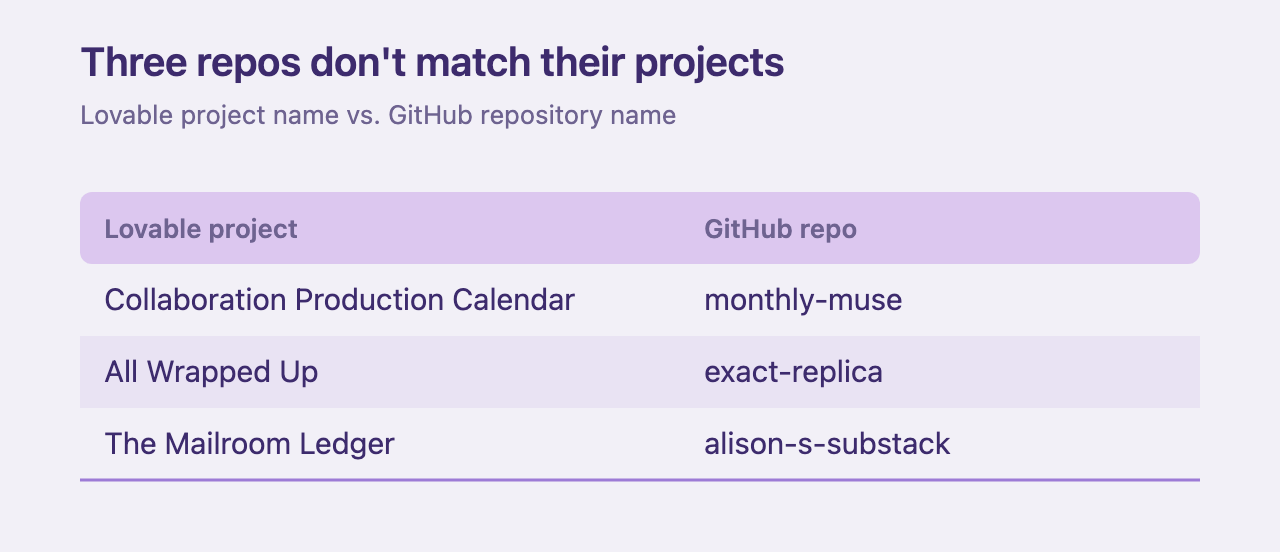
Lovable didn’t provide a way to match the project to the repository. And unfortunately a few times I forgot to change the project name from the default provided by Lovable to the name I wanted, so my repo name is strange. Three repos have names that no longer match their projects:
The surprise was Collaboration Corner, the tool I use to run collaborations on Substack. It has no repo at all. Its only trace on GitHub is a mention in the Calendar’s plan file, as a project Lovable could look at but not change. A tool I depend on lives only inside Lovable. That’s a little housekeeping I’ve been skipping.
What 64 days taught me
The numbers describe someone who builds in bursts and works late. She keeps a few tools going and is getting faster at starting new ones. She treats her rest days more as suggestions than rules.
I didn’t expect the growth to be so steady once I came back. Every full month since August beat the one before it. I also didn’t expect to see my habits so plainly: the Saturday sprints, the Friday 11 p.m. peak, the November slide on my own boundary.
The heatmap runs to December 31, and the last six weeks are still dashed outlines. I’ll fill them in and report back. I’d like more of those Wednesday and weekend squares to stay empty, and I’d like Collaboration Corner to have a repo by then.
I love the amount of data you tracked and shared in this post!