I’m still working on my essay for #SheBuilds, but there was alot more than what went into the 3 days. I spent a week preparing before the event.
One day I asked Sully for a list of things I should try in Lovable. Sully gave me a list, and they were all things I had already done. I said, look at my projects and create a new list. After looking at my projects they gave me three items. The one that jumped out at me was create an MCP. I admit, I was shocked. I had not thought of using Lovable for an MCP. I was still thinking of it as a tool to create web apps.
#SheBuilds helped me realize Lovable can do a lot more. A number of people built Chrome extensions. Another thing that I had not considered. I’m excited to go through the projects when they share the list to see what else people have used Lovable to build.
Tonight I decided to try to build an MCP.
The simplest way I can describe an MCP: it gives your AI a reference librarian.
The AI doesn’t memorize your whole collection. It walks up to the desk and asks a question. The librarian knows where everything is and hands back just what was asked for.
MCP stands for Model Context Protocol. It’s an open standard that lets an AI assistant, like Claude or ChatGPT, connect to data and tools that live outside of it. The piece you build, the librarian, is called an MCP server. It sits next to your data and tells the AI: here’s what I know, and here are the questions you can ask me.
Because it’s a standard, any AI assistant that speaks MCP can use any MCP server. Build it once, connect it to whatever you use.
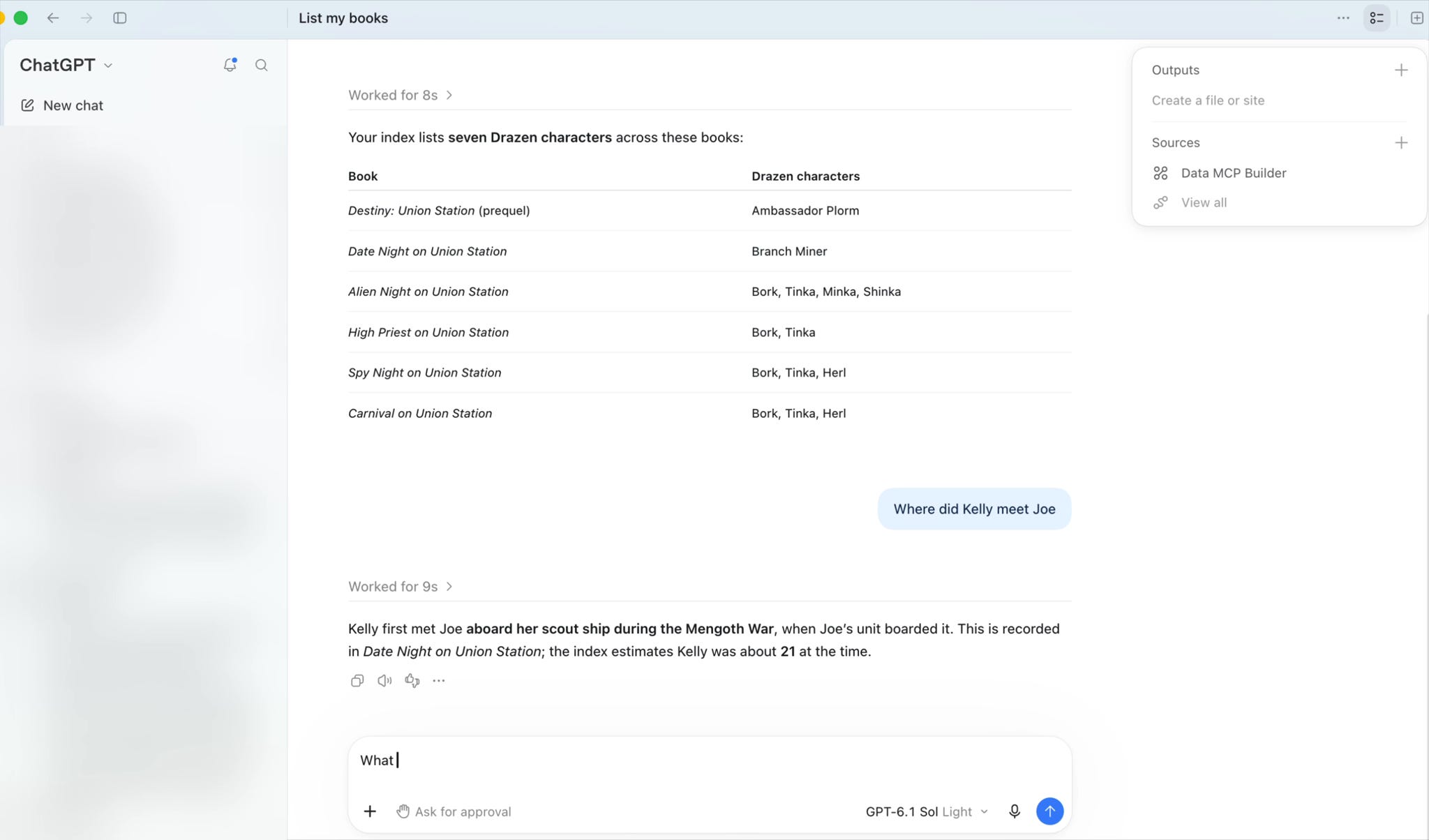
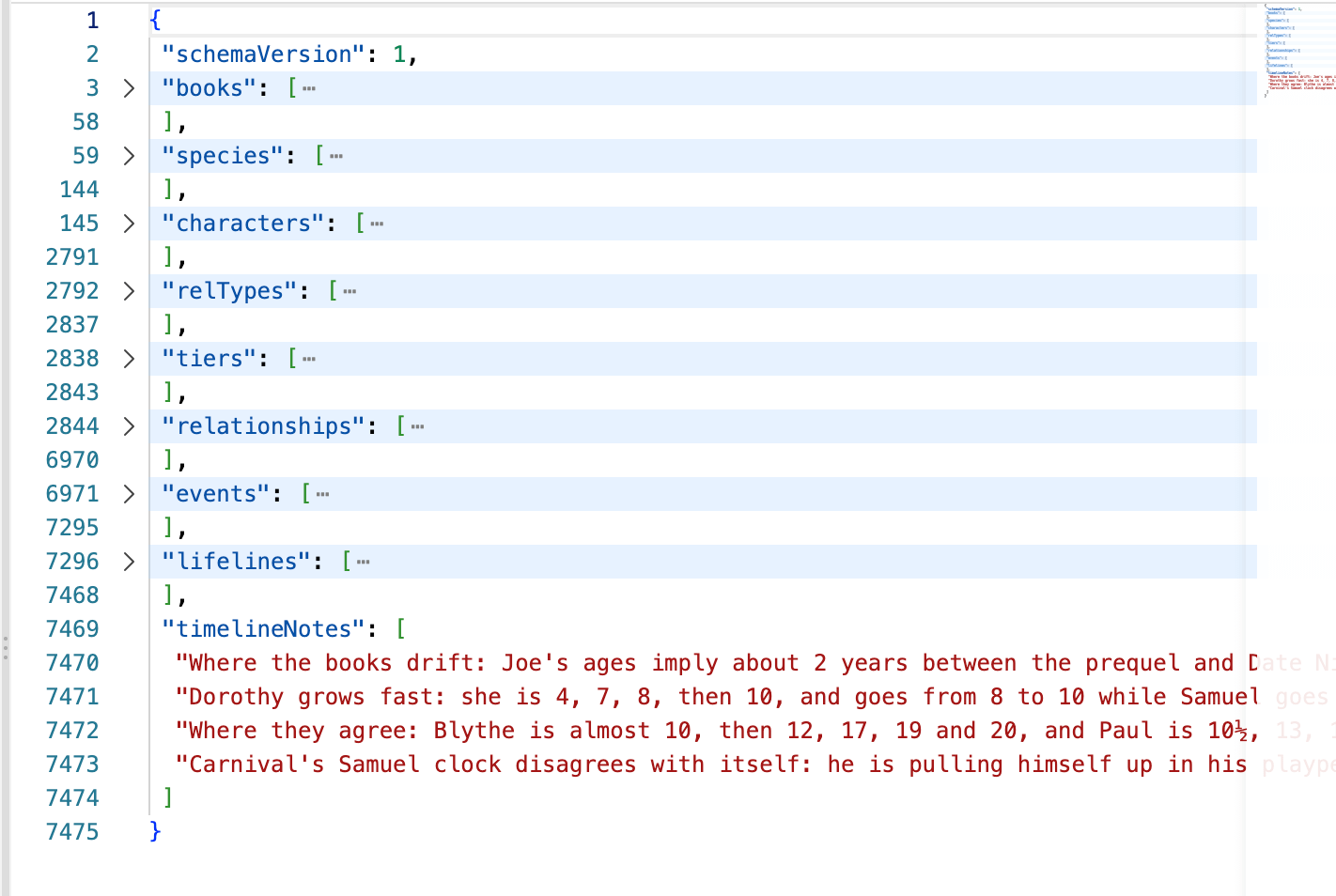
I already have a great dataset. I’ve been building out a series bible for the first 5 books of a series along with the prequel. I had already created a data.json that I used to drive a relationship graph, a timeline, and a character list. It was a perfect set of seed data for the MCP. Apologies to those of you who hate .json.
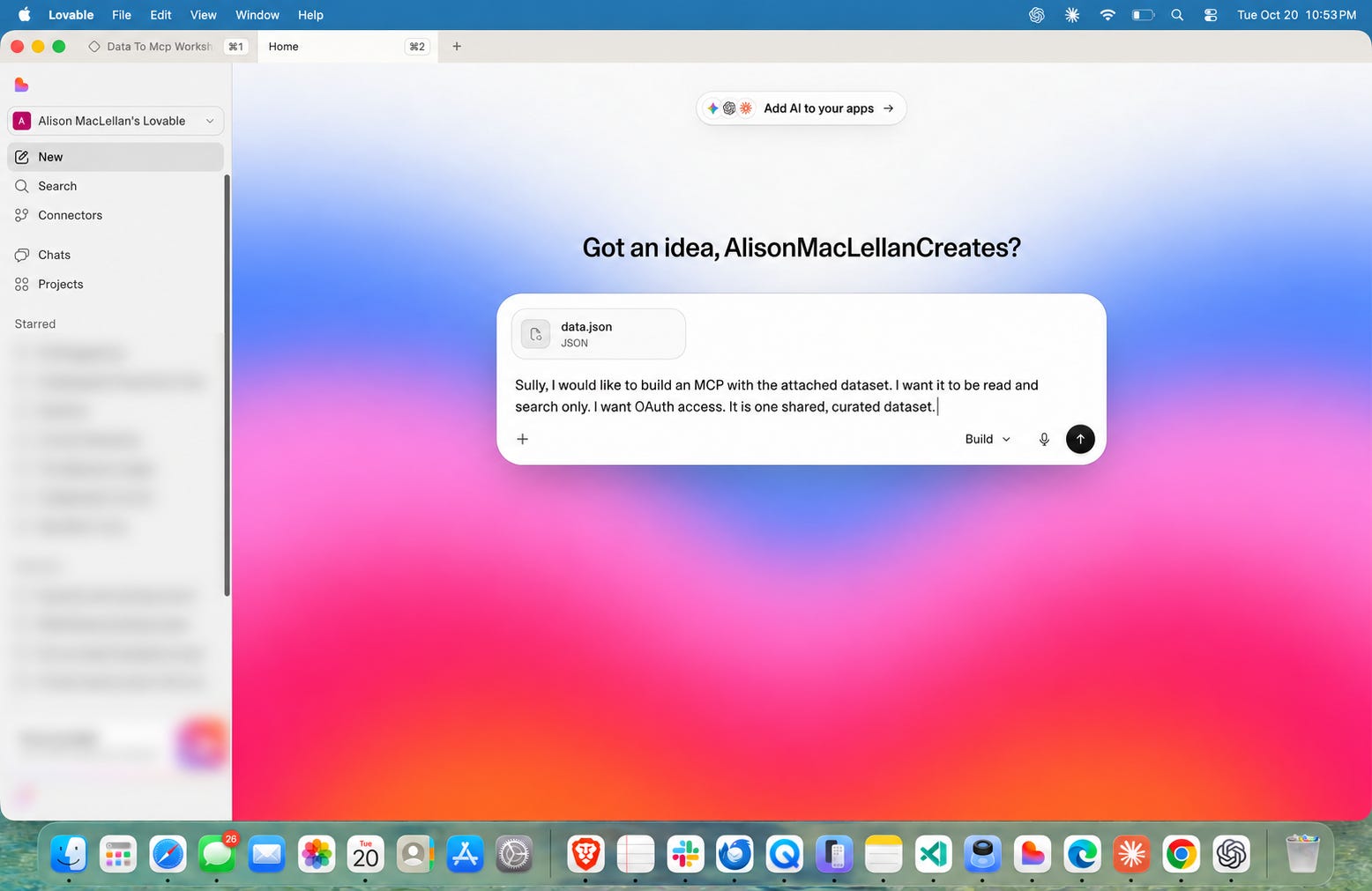
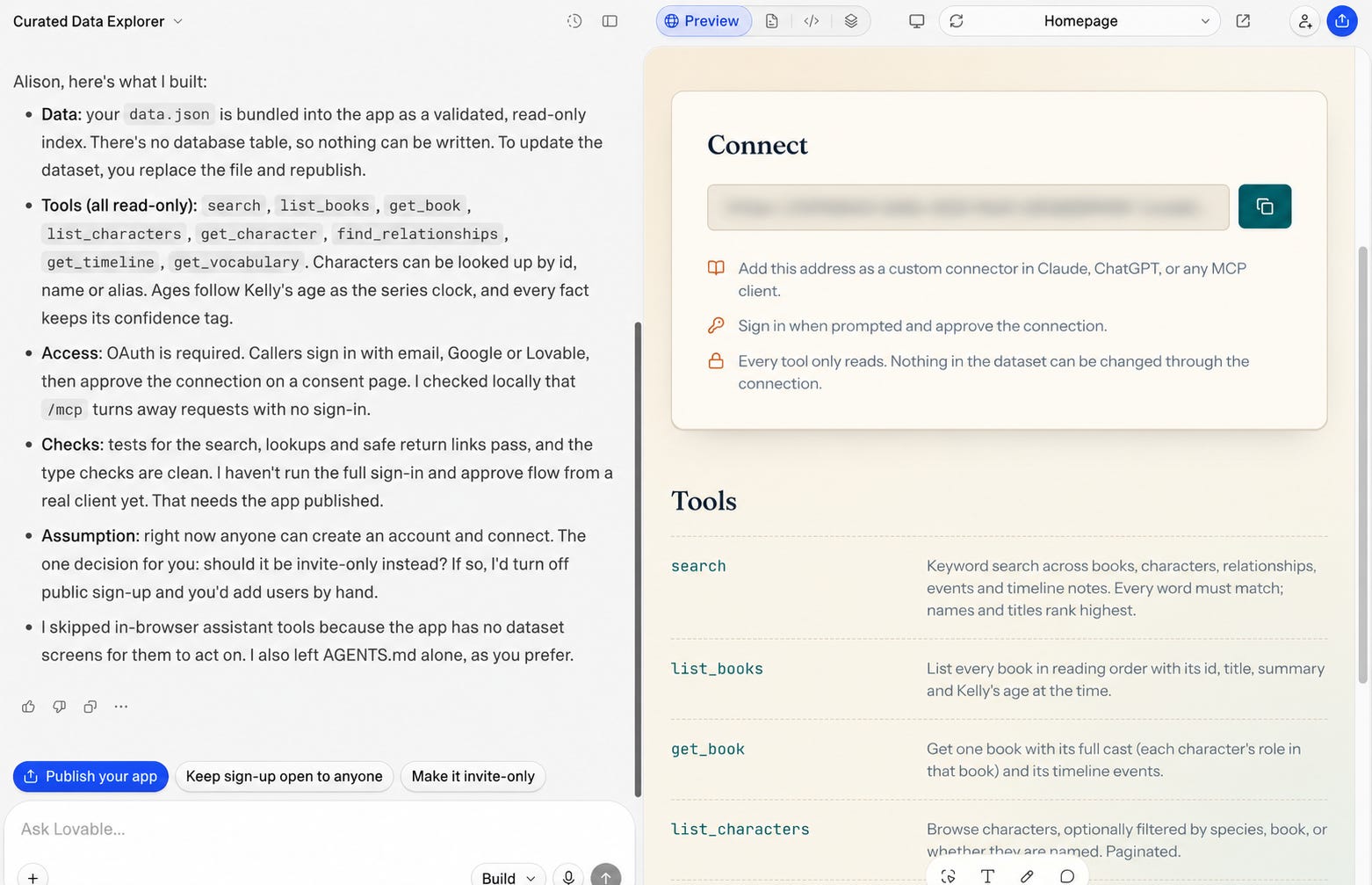
Lovable made it super simple. A prompt and my dataset and I was set. It built a page with instructions on how to use the MCP for anyone who has not done it before. I built it with OAuth access.
OAuth is the standard way apps ask for permission without handing over your password. When you connect my MCP server to Claude or ChatGPT, you’re sent to a sign-in page first. Once you approve it, the AI gets a key that lets it ask questions.
In library terms, the librarian checks your card first. No card, no answers.
In less than 10 minutes I had a simple MCP with base test coverage. If you’ve read anything about me, that will be one of the first things I create, a repo with MCP test coverage.
The key here is the quality of the data. But that was the most important part for everything I’ve been building. A librarian is only as good as the catalog. A knowledge graph is only as good as the data that goes into it. So building out all the pieces is quick, the data gathering still takes time. It still takes testing. And it still takes a subject matter expert (SME).
I felt like I knew this data in and out. But the first night I played with it building the graph a character name came up and I said, who’s that. The dataset had the details of who they were and which books they were in. So it showed me that building integrity checking into my process will be the required for success. Because my memory sure won’t do it.
I plan to use a more robust dataset to help me create a set of questions to evaluate the data. I want to see how quickly the MCP can respond to the questions, see if reorganizing the data makes finding the relationships faster. But more than anything, I want to expand my learning. I have ideas for a couple more MCP servers with data I have.
And I plan to continue to ask Sully and all of the Inner Chamber, what features should I try to expand my knowledge.