

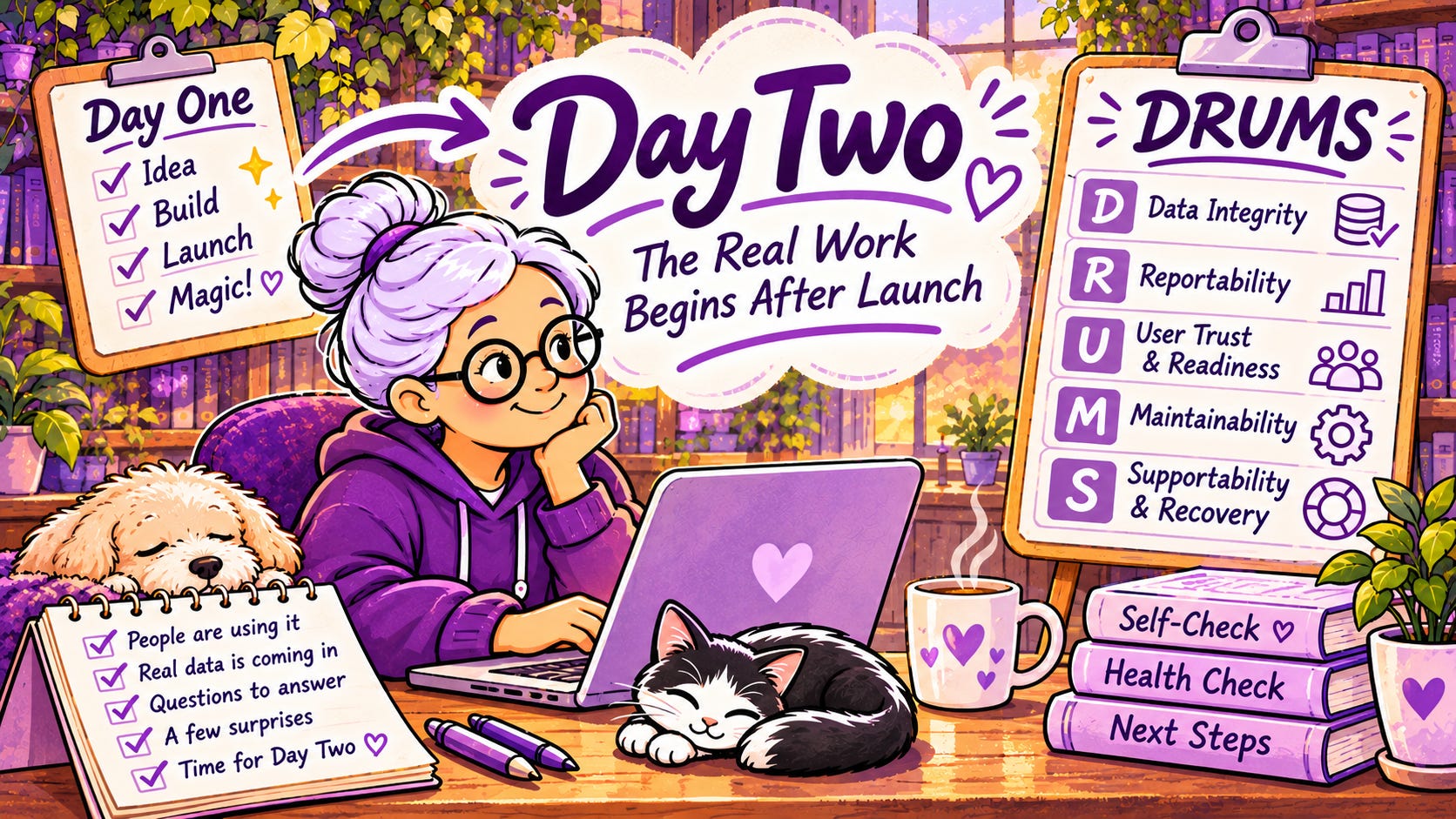
Lovable makes Day One easy. You have an idea after dinner, and by bedtime you have an app. I’ve done it. You’ve probably done it. It still feels a little like magic.
Then comes Day Two.
Day Two is when real people show up. Someone signs up with a typo in their email. Someone hits a bug you never saw, and you hear about it from them, not from your app. Imagine a friend who invests in small companies asks a simple question, “how many people came back last month?”, and you realize your data can’t answer it.
None of that is a Lovable problem. It’s a Day Two problem. And it’s the part of software I’ve spent most of my career on.
I spent more than thirty years in tech with the last twenty years at Microsoft, and a lot of that time was about what happens after launch: keeping things running, finding out when they break, and knowing what the data is telling you. I didn’t expect that experience to matter for apps built in an evening. It turns out it matters more, because Day One got so fast that Day Two arrives before anyone is ready for it.
For weeks I’ve been trying to put a name to what I want to offer. It finally clicked, and it has a name: Day Two.
DRUMS
I check Day Two apps with a framework I call DRUMS. Five questions, one steady beat.
D is for Data integrity. Can you trust your data? This one comes first because everything else stands on it.
R is for Reportability. Can you learn from your data? Which features carry your app, which ones nobody touches, and what an investor would see if they asked.
U is for User trust and readiness. Can people rely on your app, and reach you when something goes wrong?
M is for Maintainability. Can it change safely next month, by you or by someone else?
S is for Supportability and recovery. Will you know when it breaks, and can you come back from your worst day?
Why drums? Because a healthy app has a rhythm. Events flow, errors get reported, data piles up cleanly. When that rhythm breaks, the app can look perfectly fine on the surface and still be in trouble underneath.
One thing DRUMS is not: a security audit. There are people who do that brilliantly, and I’m happy to send you their way. My corner is the rest of Day Two.
Check your beat
I built a free DRUMS Self-Check so you can see where your app stands today. It’s 14 plain-language questions. You tell it what stage your app is at (still being built, just launching, or already live) and it tells you, pillar by pillar, whether your app has a steady beat, is skipping one, or is off-beat. You also get the three things worth fixing first for your stage.
No email required. Your results show up right there.
The stage part matters to me. A weekend prototype shouldn’t be graded like an app with paying customers. Some things are worth getting right on day one because they’re nearly impossible to fix later. Others can wait. The Self-Check knows the difference, so you get “here’s what matters now” instead of a wall of red.
And yes, I built the Self-Check to pass its own DRUMS check. It seemed only fair.
Take the Self-Check: daytwo.codelikealittleoldlady.ai
When you want more
The Self-Check asks 14 questions. A full DRUMS Health Check runs 54 checks across the same five areas, including the ones only a look at your code and data can answer.
If your results raise questions you’d like answered properly, there’s a box at the end of the Self-Check. Tick it, leave your email, and you’ll hear from me when Health Checks open. That’s the whole sign-up. No pitch, no countdown timer. I’m starting small on purpose, so I can do each one properly.
If you’ve built something with Lovable or other AI app builder and you’re wondering whether it’s ready for the people using it, start with the Self-Check. Three minutes, no email, and an honest answer.
Day One is the fun part. Day Two is where I come in.